Touching Tomorrow atPukyong National University
NEW BEGINNING, NEW INSPIRATION
Pukyong Today List
| What research did journal Nature's sister journal focus on? | |||
| WRITER | Department of External Cooperation | WRITE DAY | 2019-12-26 |
| COUNT | 292 | ||
| What research did journal Nature's sister journal focus on? | |||||
 |
Department of External Cooperation |  |
2019-12-26 |  |
292 |
|
"High density of Han River, up to 6 times the concentration of lithium in water"
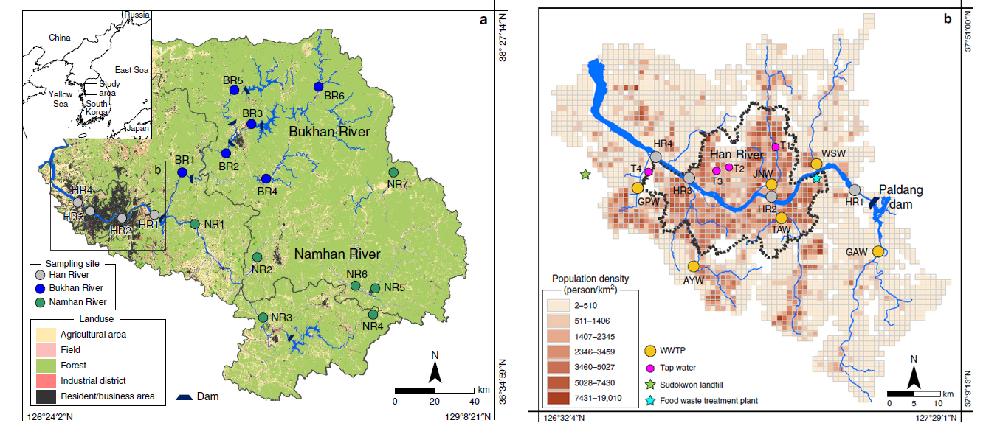
Professor Ryu Jong-sik (Department of Earth Environmental Sciences), Pukyong National University, presented the results of lithium content and isotope surveys on river water, tap water, and potential pollutants in the Han River in the international journal <Nature Communications>. In this research, jointly conducted with the Korea Basic Science Institute (KBSI) and the French National Center for Science and Research (CNRS), professor Ryu collected and investigated water from 17 locations, including six spots from Bukhan (North Han) rivers, seven spots of Namhan (South Han) rivers, and four from Han rivers and anounced the results. According to the survey, lithium concentrations of samples taken from the North and South Han rivers were lower than those from other countries, but samples from the Han river passing through Seoul showed up to six times higher lithium than those from the two rivers. The researchers found that the lithium content in the river rapidly increased as the population density increased, and pointed to artificial substances such as lithium-ion batteries and manic-depressive drugs. Professor Ryu Jong-sik, a corresponding author of the study, said, “Recently, the demand for lithium ion batteries has been rapidly increasing due to the development of various digital devices and the expansion of electric vehicles. However, the recovery, recycling and treatment system of waste lithium ion batteries have not been established in Korea. Although it is likely to become a potential environmental pollutant in the future, little research has been conducted on the effects of human factors on the lithium content in nature.” The team also confirmed that current water treatment plant and water treatment technologies cannot remove lithium. The treated and tap water analysis in the sewage treatment plant treating the wastewater from the Han River basin showed that the lithium concentration and isotope ratio before and after the wastewater treatment were hardly changed. Professor Ryu said, "To minimize the adverse effects on the ecosystem and human body caused by artificial lithium pollution in the future, it is necessary to prepare solutions and further research, such as the management of waste lithium secondary ion batteries." <Pukyong Today> |
 The research results that the cause of the increase in lithium concentration in the Han River is due to artificial materials such as lithium secondary ion battery is attracting attention.