-
대학/대학원
-
연구/산학
-
대학생활
-
입학/취업
-
커뮤니티
-
대학소개
-
개교 80주년
커뮤니티
부경투데이
- 국립 부경대학교의 다양한 모습과 소식을 접하시면 부경대학교가 한번 더 가까워집니다.
| 교수님, 잠깐만요 | 정근주 교수(Give us a sec, professor | Prof. Jeong Geun-joo) | |||
| 작성자 | 대외협력과 | 작성일 | 2021-03-25 |
| 조회수 | 1694 | ||
| 첨부파일 | |||
 정근주 교수-빛 반사 연구(2021.3.24.).jpg
| 교수님, 잠깐만요 | 정근주 교수(Give us a sec, professor | Prof. Jeong Geun-joo) | |||||
 |
대외협력과 |  |
2021-03-25 |  |
1694 |
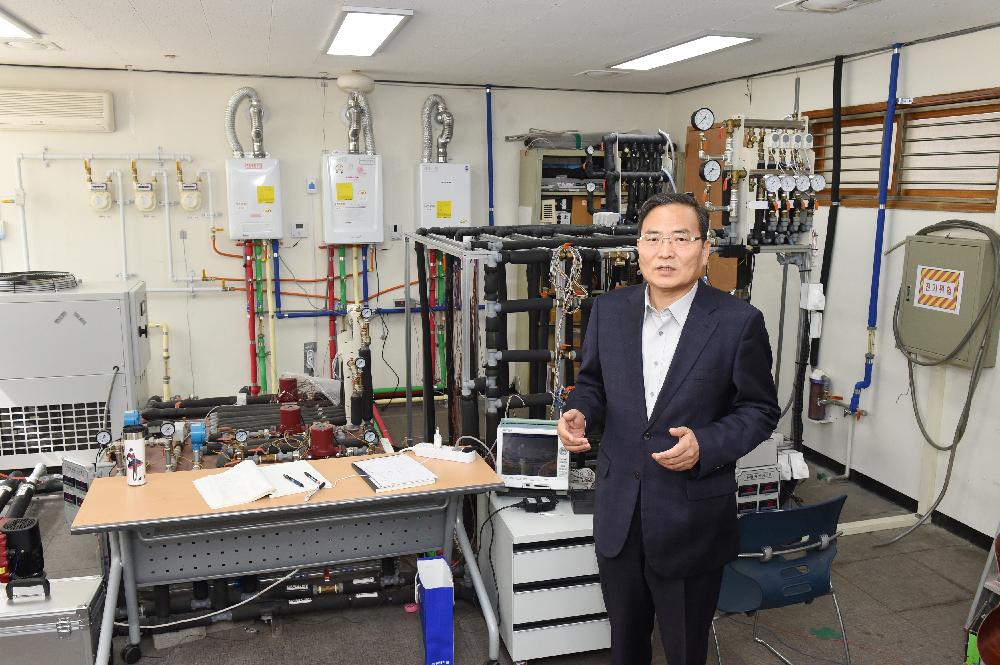
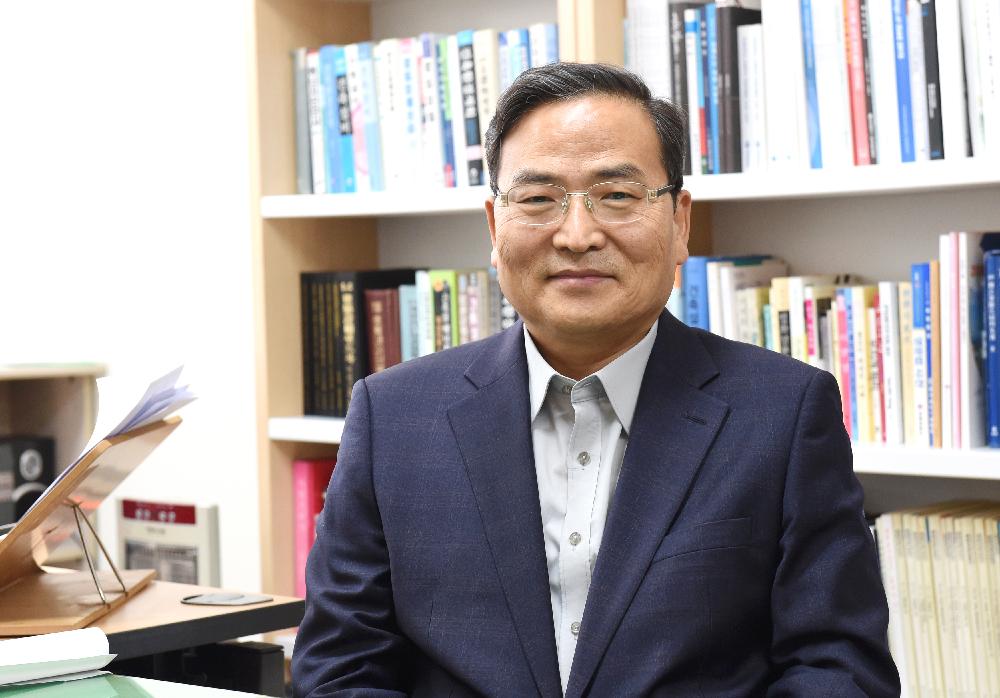
부경대학교 정근주 교수(60·건축공학과)와 인터뷰를 하고 싶다며 연결해 달라는 언론사 기자들의 전화가 최근 홍보팀에 잇달았다. 무슨 일일까? 지난 3월 11일 나온 ‘초고층 건물 빛 반사 피해’ 대법원 판결에 정 교수의 연구결과가 결정적인 ‘가늠자’ 역할을 했기 때문이다. 이날 대법원은 부산 해운대구 우동의 주민들이 현대아이파크 시공사인 HDC 현대산업개발을 상대로 낸 손해배상 소송 상고심에서 원고 일부 승소 판결을 한 원심을 확정했다. 이번 대법원 판결은 초고층 건물의 빛 반사 피해를 처음 인정했다는 점에서 세간의 뜨거운 주목을 받고 있다. 소송 12년 만의 결론이었다. 그동안 어떤 일이 일어났을까? 초고층 건물의 빛 반사로 피해를 호소하는 주민들의 소송은 2009년 처음 시작됐다. 1심에서는 주민들이 졌다. 주민 피해를 인정할 만한 증거가 없다는 것이었다. 그래서 2심(부산고법) 법정은 2011년 8월 정 교수가 책임연구자로 있는 부경대 건축환경연구실에 감정의뢰를 하게 된다. 주민 피해상황을 연구 조사해달라는 것이다.
이 감정 보고서는 이번 소송의 결정적인 단초가 됐다. 이 감정 보고서를 근거로 2013년 6월 부산고법은 주민들이 과다하게 비치는 빛으로 사물 식별이 어렵게 되는 ‘불능현희’ 피해를 입고 있다는 점을 인정했다. 피해주민 일부에게 1인당 132만원에서 678만원까지 모두 2억 원 가량을 지급하라고도 판시했다. 정 교수는 “우리 연구팀의 현장조사와 시뮬레이션 결과, 해운대아이파크(피고)가 햇빛을 경면(거울) 반사시킴으로써 경남마리나아파트(원고)에 수인한도를 넘는 불능현휘를 발생시키는 것으로 나타났다.”고 연구 결과를 소개했다. 이어 그는 “빛의 휘도는 현장조사에서 300,000 cd/㎡를 초과하고, 컴퓨터시뮬레이션으로는 최대 70,000,000 cd/㎡ 내외로 나타났다. 이는 수인한도인 25,000 cd/㎡를 훨씬 초과하는 것.”이라고 설명했다. 정 교수는 “건물이 점점 고층화하여 유리 자재를 많이 쓸 수밖에 없다. 건물이 높아질수록 건물 하중이 가벼워야하기 때문이다. 또 외관이 매력적인 소재이고 실내에서의 투시성이 좋다는 점도 유리를 선호하는 이유다.”고 말했다.
건축공학 및 건축 환경 분야가 그의 전공이다. 그는 2007년 부경대 교수로 부임하기 전에 건원ENG와 삼성중공업 등 산업현장에서 쌓은 노하우를 바탕으로 건축 환경이라는 장르를 독보적으로 펼쳐가고 있다. 그는 ▷에너지절약을 위한 냉난반 등 ‘열 환경’을 비롯, ▷실내조도와 실외 빛 공해 등을 다루는 ‘빛 환경’, ▷소음문제와 음향시설 등을 다루는 ‘음 환경’ 분야를 주로 가르치고 연구한다. 그동안 ‘건축공학’ 분야의 주류는 건축 현장의 시공 관리와 구조분야로 인식되어 왔다. 그러나 이번 대법원 판례에서 보듯, 건축 환경 분야 학문의 중요성이 대두되고 성장 가능성도 큰 학문으로 주목받고 있다. 정 교수는 건축 환경 및 설비 분야에 관한 69편의 연구논문(SCI 11편)을 발표했다. 건축문화 발전에 기여한 공로로 국토교통부장관 표창, 한국건축친환경설비학회 논문상 등을 받은 바 있다. 학사와 석·박사 학위를 모두 부경대에서 공부한 그는 공과대 부학장, 기획부처장, 기획처장 등 보직을 역임하며 학교 발전을 위해 노력했다. 그는 “건축 환경은 환경보호와 에너지 절약이라는 인류의 숙제를 해결하기 위해 발전시켜야할 중요한 학문.”이라면서, “우리 학생들이 건축 환경 분야를 제대로 탐험하고 각자의 꿈을 키워갈 수 있도록 최선을 다하겠다.”고 말했다. <부경투데이> The media attention surrounding the judgment on the first case 'harm caused by light reflected from a skyscraper' Recently, the university's public relations team has received many phone calls from reporters asking to interview Professor Jeong Geun-joo (age 60, Dept. of Architectural Engineering) at Pukyong National University. What is the story here? That is because Professor Jeong's research results played a decisive role in the Supreme Court's decision about 'harm caused by light reflection from skyscrapers' that was released on March 11th. On that day, the Supreme Court affirmed the trial court decision on a lawsuit in which residents residing in U-dong, Haeundae-gu, Busan, filed against HDC Hyundai Industrial Development, the construction company of Hyundai I-Park. The Supreme Court's judgment is drawing public attention as it was the first to admit light reflected from skyscrapers causes harm. This was the conclusion of the 12-year lawsuit. What happened in the meantime? A lawsuit was filed by residents complaining of being harmed by light reflected from the skyscrapers first began in 2009. Residents lost in the first trial. There was no data that the reflected light caused the residents were suffering. Because of the lack of data, in August 2011, a second trial (Busan High Court) court commissioned the Architectural Environment Laboratory at Pukyong National University, where Professor Jeong is the lead researcher to conduct a study. They asked for an investigation on the feasibility of damage to residents. After two months of research by Professor Jeong's research team, an investigation report titled 「Disabling Glare and Life Disturbance Problems at the Gyeongnam Marina Apartment Caused by Haeundae I-Park's Spectacular Reflection」 was presented. This report marked a decisive moment in the lawsuit. Based on this report, in June 2013, the Busan High Court admitted that residents are suffering harm from 'disabling glare', making it difficult to identify objects due to excessive light. It was also decided that approximately 200 million won was to be paid to victims, ranging from 1.32 million won to 6.68 million won per person. However, due to the construction company's objection to the second trial’s verdict, the lawsuit went to the Supreme Court, and five years later, on the 11th of March, the Supreme Court confirmed the lower court’s judgment. "There is a disturbance of life that exceeds tolerable limits due to sunlight reflected by the glass on the outer wall of the building." The residents finally won. Professor Jeong presented the research results. "As a result of our research team's on-site investigation and simulations, it was found that Haeundae I-Park (the defendant) reflected sunlight in a specular surface (mirror), causing a disabling glare to exceed tolerable limits in the Gyeongnam Marina Apartments (the plaintiff)." He continued, "the luminance of light exceeded 300,000 cd/m2 in the field survey, and the maximum was around 70,000,000 cd/m2 in computer simulation. This far exceeds the limit of 25,000 cd/m2." Professor Jeong said, "buildings are getting taller and taller, and glass is inevitably used. This is because the higher the building, the lighter the building load is required. In addition, the attractive exterior and striking view from inside is another reason to prefer glass." He stressed, "therefore, it is necessary to review [light reflection] in advance in the architectural design stage to prevent light reflection problems. It should be designed in consideration of whether it causes damage to nearby residents." Professor Jeong, who provided vital evidence to this unparalleled judgment, is considered to be an architectural engineer who is endowed with both practical and theoretical skill. His majored in the fields of architectural engineering and environmental architecture. Prior to his appointment as a professor at Pukyong National University in 2007, he stood unrivaled in the field of environmental architecture based on know-how that he accumulated working in industrial sites such as Kunwon Engineering and Samsung Heavy Industries. He mainly teaches and studies the field of ▷’environmental lighting design’ dealing with indoor illumination and outdoor light pollution, ▷'thermal design’ such as heating and cooling for energy conservation, and ▷'acoustic design’ dealing with noise problems and sound features. The mainstream field of 'architectural engineering' has become more a field of construction management and single structure design. However, as shown in the case of the Supreme Court's judgment, the importance of the environmental architecture field has been recognized and is attracting attention as a field of study with great growth potential. Professor Jeong has published 69 research papers (11 SCI papers) on the field of environmental architecture and equipment. For his contributions to the development of the architectural, he received a citation from the Minister of Land, Infrastructure and Transport (MOLIT), and a thesis award from the Korean Institute of Architectural Sustainable Environment and Building Systems (KIAEBS). Having receive his bachelor's and master's and doctoral degrees at Pukyong National University, he served as vice provost of the College of Engineering, the vice director of Planning and Administration, and director of Planning and Administration, he has devoted himself to university development. He said, "environmental architecture is an important field of study that needs to be developed to solve humanity's problems of environmental protection and energy conservation," he added, "I will do my best to help my students properly explore the field of environmental architecture and develop their own dreams." <Pukyong Today> |

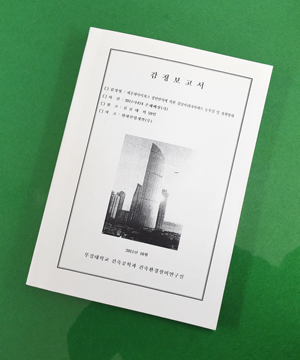 정 교수 연구팀의 2개 월 여의 연구 끝에 나온 것이 「해운대 아이파크 경면반사에 의한 경남마리나아파트 눈부심 및 생활 방해」라는 제목의 감정 보고서였다.
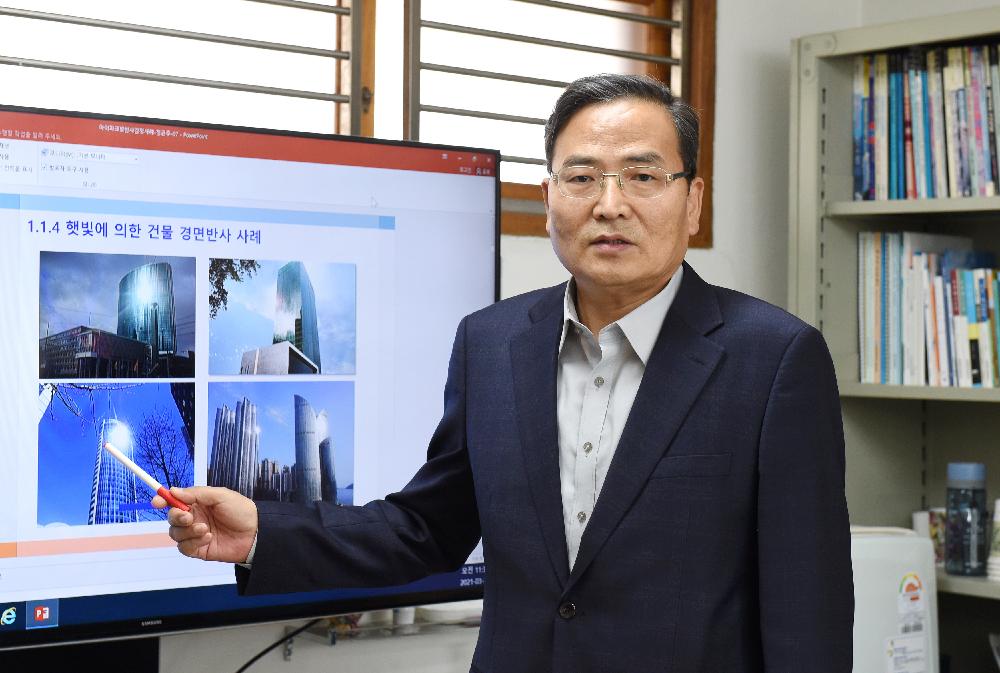 그는 “그래서 건축 디자인 단계에서 미리 검토해서 빛 반사 일어나지 않도록 해야 한다. 인근 주민 피해 여부도 고려하여 설계해야한다.”고 강조했다.