

△ 이보람 교수. ⓒ사진 이성재(홍보팀) |
부산 국립부경대학교 교수의 차세대 디스플레이 소재 연구가 세계 3대 과학저널인 <네이처(Nature)>에 실리며 주목받고 있다.
한국연구재단은 부경대 이보람 교수(물리학과)의 논문 ‘Ligand-engineered bandgap stability in mixed-halide perovskite LEDs’가 국제학술지 <네이처>에 게재됐다고 3월 11일 밝혔다.
이 논문은 유기발광소자(OLED)에 이어 차세대 디스플레이로 떠오르고 있는 페로브스카이트 발광소자(PeLED)의 발광효율과 색 안정성을 크게 향상시킨 결과를 제시해 관심을 모으고 있다.
높은 색 순도와 색 조절까지 용이한 소재로 초고선명 디스플레이의 조건을 갖춘 ‘금속 할라이드(유기-무기-할로겐 유형 화합물) 페로브스카이트’ 발광체가 주목받고 있지만, 색 안정성 확보가 문제였다.
적색과 청색을 얻기 위해서는 둘 이상의 할라이드를 혼합해야하는데, 외부자극에 의해 쉽게 분리돼 발광색이 바뀌는 현상이 발생한다.
이 교수는 부경대, UNIST 등 한국을 비롯해 영국 옥스퍼드대, 케임브리지대, 미국 오리건대 등 국제공동연구팀과 진행한 이번 연구에서 외부양자효율을 기존 4.1 %에서 20.3 %로 크게 향상시킨 것은 물론, 높은 색 안정성도 확보한 적색 PeLED 개발에 성공했다.
이 교수 연구팀은 납(Pb)과 킬레이트 결합을 하는 두 종류의 리간드(배위화합물이나 착화합물에서 중심원자와 결합하고 있는 원자나 분자)를 페로브스카이트 나노결정에 처리해 나노결정에 존재하는 결함을 제거하는데 성공했다.
리간드 처리를 통해 표면결함을 제거한 페로브스카이트 나노결정은 표면결함이 존재하는 나노결정보다 1.5배 향상된 발광효율(광발광 양자효율)을 보였고, 나노결정을 발광소자에 적용했을 때 외부양자효율은 기존 4.1 %에서 20.3 %로 크게 향상되는 것으로 나타났다. 또 리간드를 처리한 페로브스카이트 나노 결정 발광소자는 소자 구동 시 일정한 발광 스펙트럼으로 높은 색 안정성을 보였다.
이 교수는 “이번 연구로 PeLED의 상용화를 앞당겨 TV 등 디스플레이는 물론, 점점 발전하고 있는 VR, AR 분야에서 요구되는 더욱 현실적인 색상과 현실감 있는 표현이 가능해질 것으로 기대한다.”라고 말했다.
특히 지역 학계는 이번 연구 성과가 코로나19로 더욱 어려워진 국제공동연구 환경 속에서 얻은 성과라는 점과 부산 지역 대학이 주도한 연구가 세계 3대 과학저널 중 하나에 실렸다는 점에서 높이 평가하는 분위기다.
이 교수는 “해외 대학들의 연구실이 코로나19로 폐쇄돼 추가 실험에 어려움을 겪기도 했지만, UNIST, 서울대, 한양대 등 국내 연구진들의 적극적인 지원으로 해결하고, 화상미팅으로 해외 연구진들과 접촉하며 연구를 진행해 좋은 성과를 낼 수 있었다.”라고 밝혔다.
2017년 부경대 물리학과 교수로 임용된 이 교수는 임용 이후에만 40여 편의 SCI논문을 발표했다. 이 가운데 <Nature (IF=(42.779)>, <Nano Energy (IF=16.602)>, <Journal of the American Chemical Society (IF=14.612)>, <Journal of Materials Chemistry A (IF=11.301)>, <ACS Nano (IF=14.588), 1저자> 등 저명 국제학술지에 교신저자로 논문을 게재했다. 현재 이 교수는 발광소자 및 태양전지와 같은 광전자소자 연구와 관련된 SCI논문이 총 70여 편에 이를 정도로 왕성한 연구 활동을 펼치고 있다. 울산대에서 학사, UNIST에서 박사 학위를 받았다.
그는 “물리학이 기초과학이지만 결국 연구는 삶을 윤택하게 만들기 위한 것이라고 생각해 기초학문을 바탕으로 응용연구에 힘쓰고 있다. 에너지를 빛으로 바꾸는 발광소자와 빛을 에너지를 바꾸는 태양전지는 제작 메커니즘이 유사하기 때문에 이번 연구는 태양전지, 트랜지스터의 성능을 높이는 데에도 얼마든지 응용할 수 있다. 앞으로도 실생활에 사용할 수 있는, 가치 있는 연구를 위해 힘쓰겠다.”라고 말했다.
한편 이 교수는 한국연구재단의 기초연구사업(신진연구) 지원을 받아 연구를 진행했다. 부경대도 우수논문 포상 제도에 따라 별도의 포상금을 지원할 계획이다. <부경투데이>
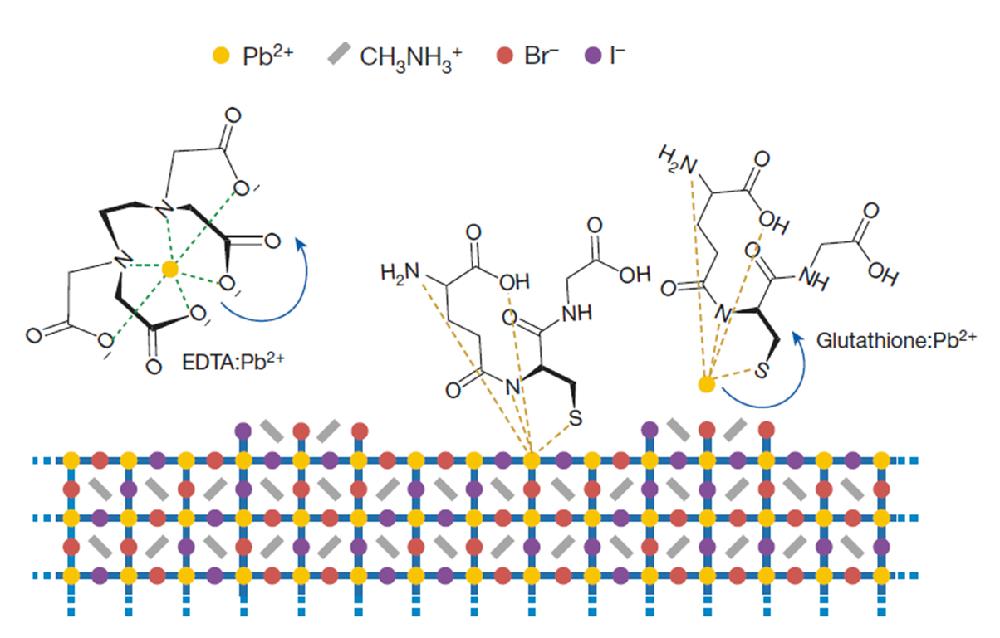
△ 페로브스카이트 표면 리간드 처리 모식도

△ 리간드 처리하지 않은 소자와 리간드 처리한 소자의 전계 발광 파장 안정성 그래프
<Nature> gave an eye to the research of next-generation display materials by PKNU professor
The research achievement of Prof. Lee Boram ... Presenting the result of improving the efficiency and stability of 'PeLED'
The National Research Foundation of Korea announced on March 11 that the paper 'Ligand-engineered bandgap stability in mixed-halide perovskite LEDs' by Professor Lee Bo-ram (Department of Physics) at Pukyong National University had been published in the international journal <Nature>.
This paper is attracting attention by presenting the result of greatly improving the luminous efficiency and color stability of the Perovskite Light-Emitting Device (PeLED), which is emerging as a next-generation display following the organic light-emitting device (OLED).
As a material with high color purity and easy color adjustment, the 'metal halide (organic-inorganic-halogen type compound) perovskite' luminous body, which has the conditions for ultra-high-definition display, is attracting attention, but in fact, securing color stability was a problem.
To obtain red and blue, two or more halides must be mixed, but they are easily separated by external stimuli which changes the luminous colors.
Prof. Lee has significantly improved the external quantum efficiency from 4.1% to 20.3% in this study conducted with international joint research teams at Oxford University in the UK, Cambridge University, the University of Oregon, and includes Pukyong National University and UNIST in Korea, it succeeded in developing red PeLED, which also secured high color stability.
Professor Lee's research team successfully removed defects in the nanocrystals by treating perovskite nanocrystals with two types of ligands (atoms or molecules bonded to the central atom in a coordination compound or complex compound) that chelate bonds to lead (Pb).
Perovskite nanocrystals from which surface defects were removed through ligand treatment showed 1.5 times higher luminous efficiency (photoluminescence quantum efficiency) than nanocrystals with surface defects, and when nanocrystals were applied to a light emitting elements, the external quantum efficiency was found to be greatly improved from 4.1% to 20.3%. In addition, the ligand-treated perovskite nanocrystalline light emitting display showed high color stability with a constant emission spectrum when the device was activated.
Professor Lee said, "Through this research, we expect that the commercialization of PeLED will be accelerated to enable more realistic colors and realistic expressions required in the increasingly developing VR and AR fields as well as in displays such as TVs."
Especially, local academia highly praised the fact that this research achievement was achieved in an international joint research environment which had become more difficult due to Corona 19, and that research led by a local university in Busan was published in one of the world's top 3 major scientific journals.
Professor Lee said, "Although the labs of overseas universities were closed due to Corona 19, and it was difficult for further experiments, it was resolved with active support from domestic researchers at places such as UNIST, Seoul National University, and Hanyang University. We were able to achieve good results by contacting overseas researchers through video meetings and conducting research."
Professor Lee, who was appointed as a professor of the Department of Physics at Pukyong National University in 2017, has published more than 40 SCI-level papers after his appointment. Among them, he has published articles such as <Nature (IF=(42.779)>, <Nano Energy (IF=16.602)>, <Journal of the American Chemical Society (IF=14.612)>, <Journal of Materials Chemistry A (IF=11.301)>, <ACS Nano (IF=14.588), lead author> as corresponding authors in eminent international journals. Currently, Professor Lee is actively conducting research activities with a total of 70 SCI papers related to research on optoelectronic devices such as light emitting displays and solar cells. He received a bachelor's degree from Ulsan University and a doctorate from UNIST.
He said, "Although physics is a basic science, in the end, I think that research enriches life, so I am working on applied research based on basic science. Since the manufacturing mechanism of a light-emitting device that converts energy into light and a solar cell that converts light into energy have similar manufacturing mechanisms, this research can be applied any number of ways to improve the performance of solar cells and transistors. In the future, we will continue to do our best on valuable research that can be used in real life."
Meanwhile, Professor Lee conducted his research with the support of the Basic Research (rising research) project from the National Research Foundation of Korea. Pukyong National University also plans to separately provide a reward fund in accordance with the award system for excellent papers. <Pukyong Today>
|


 이보람 교수.jpg


